An 18-month responsive-web evolution restructuring Ethicon.com around the surgical procedure, not the product SKU.
The page is the procedure. Not the product.
Ethicon is a Johnson & Johnson subsidiary and one of the largest medical-device manufacturers in the world. In 2016 Ethicon was shifting customer engagement from product-led selling to procedural selling: meeting surgeons and procurement teams at the level of the surgical procedure rather than the SKU. Ethicon.com had been built around the product taxonomy. The new strategy needed a site built around the customer's decision journey.
Atmosphere Proximity led the Ethicon.com Evolution program over an 18-month engagement. As Director of User Experience, I led the UX strategy, information architecture, content strategy, and the underlying behavioral framework that organized the redesign. The framework I built for the engagement, the Wayfinding Framework, combines two information-retrieval models from cognitive science and library science. It became the operating logic for the site and, later, for the broader Ethicon Product Resource Center.
Goals
Outcomes the program had to make possible against Ethicon Global's top-level digital objectives.- Shift customer engagement from product-led to procedural-led.
- Restructure information architecture for Ethicon.com and the future Ethicon Product Resource Center (EPRC).
- Deepen online engagement with core clinical audiences: surgeons and procurement teams.
- Strengthen Ethicon's positioning as the digital innovation leader in surgical solutions.
- Enrich and strategically focus field-rep conversations with customers.
- Realign site search, navigation, and taxonomies to support both exploratory and task-oriented user behavior.
Framework
A blend of cognitive science, human-computer interaction, information retrieval, and library science, adapted for clinical B2B eCommerce.The redesign was anchored in a framework I developed for the engagement, the Wayfinding Framework. It combines two information-retrieval models from the research literature, both grounded in how people actually search through complex information spaces.
The Classic model
Task-oriented retrieval. The user has an information need, formulates it as a query, the system returns a set of relevant objects, the user judges what's useful. Affordances that serve this mode: CTAs, search, utility navigation (my profile, my orders), product specifications, structured data.
The Berry Picking model Bates, 1989
Exploratory retrieval. The user's information need is not satisfied by a single final retrieved set, but by a series of selections and discoveries along an ever-modifying search path. The pattern is a random walk of unpredictable steps toward a general goal, often across multiple sessions. Affordances that serve this mode: main navigation as mental-model scaffolding, content cross-linking, product recommendations, landing pages with overview content.
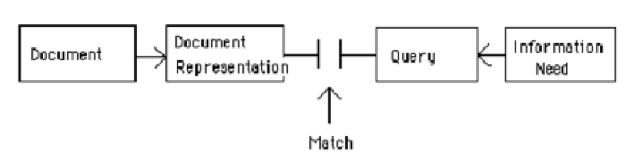
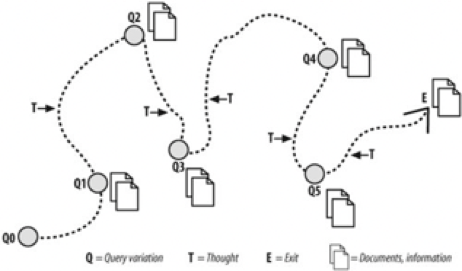
The Wayfinding Framework holds that every page in a complex B2B eCommerce site must accommodate both modes simultaneously. Clinical audiences move between task and exploration within a single session and across multiple visits. Treating those as separate audiences, or building separate pages for each, leaves the page broken for whoever isn't being served at the moment.
A competitive analysis across the surgical-device category positioned the work in context: GE Healthcare was leading on digital content innovation; Medtronic was underinvesting in public-web presence; the strongest comparators outside healthcare were using gamified interfaces and segmented content to establish thought leadership. The framework let Ethicon play category-leadership rather than parity.
Every page accommodates both modes. Task and exploration. Because clinical users move between them within a single session. Wayfinding Framework · operating principle
Two retrieval paths, the same page anatomy. Task affordances above the fold. Exploration affordances below.
Solution
The final design organized every visitor pathway around the surgical procedure, not the product SKU.Every IA, navigation, content, and interaction decision in the redesign was driven by the framework. The page anatomy became the operating contract: task affordances above the fold, exploratory affordances below, both modes available on every page.
One navigation system across all pages
Primary, secondary, and utility navigation rendered consistently on every template, to build a stable mental model users could carry across sessions.
Procedure-led main navigation
Specialty-specific content surfaced under "Procedures" in main navigation, encouraging clinical audiences to view Ethicon's leadership at the procedural level rather than the product level.
Restructured taxonomies
Main navigation (faceted) and page-level taxonomies (hierarchical) re-architected based on element traits, intent signals, and implicit relationships, to support task completion across both modes.
Faceted site-wide search
Search redesigned to yield a faceted results page that aligned user needs with organizational goals. Filtering became part of the discovery surface, not a separate page state.
Reciprocal page-level hierarchies
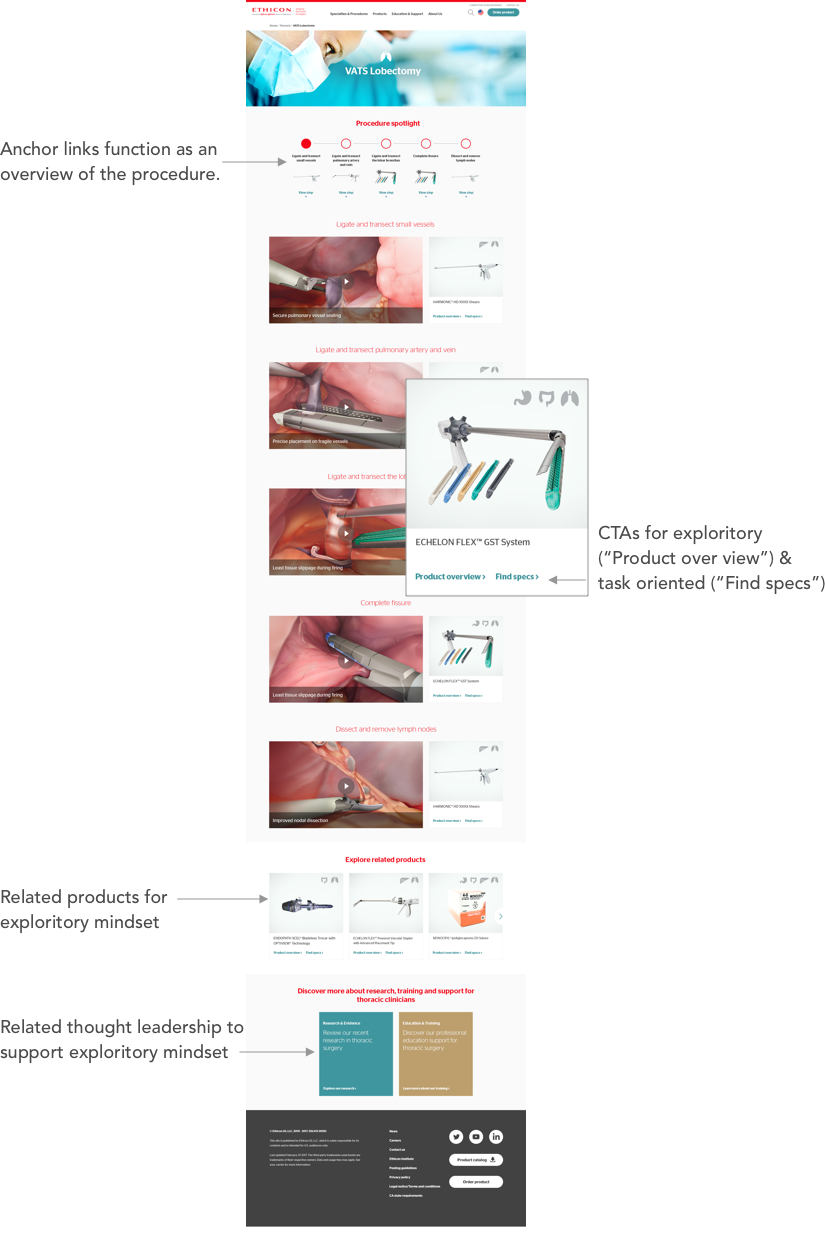
Page anatomy designed to support both modes of the Wayfinding Framework on every template. Task affordances above the fold. Exploratory affordances below. Page-level hierarchy reciprocated main navigation.
Procedure landing page as template
One canonical procedure landing page became the model for the rest of the site. Content organized around the surgical procedure, with the two-mode anatomy applied at scale.
Customer journey stages
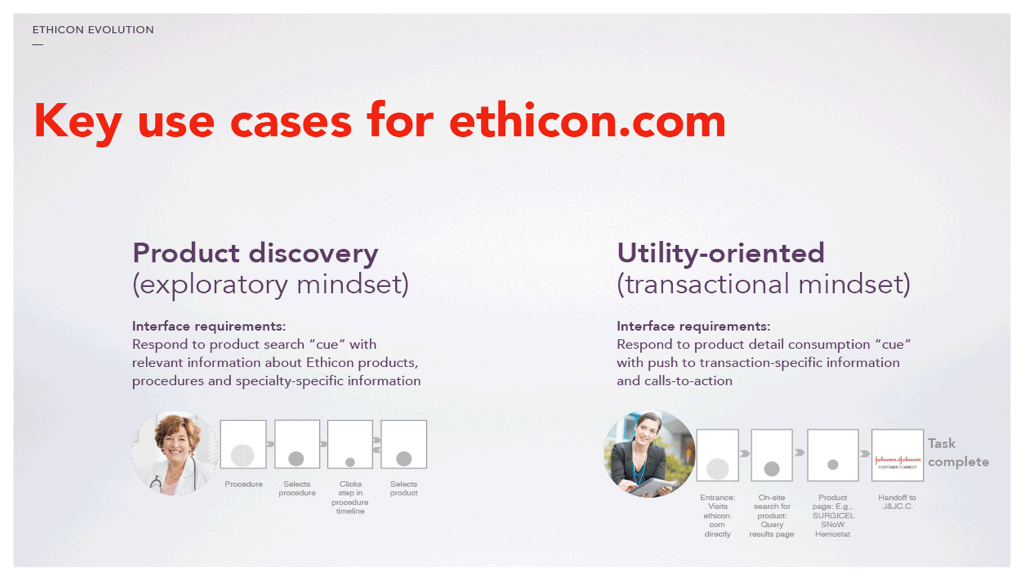
Awareness, Consideration, Trial, Repeat Usage, Loyalty. The Berry Picking exploratory mode dominates Awareness and Consideration. The Classic task-oriented mode dominates Trial and Repeat Usage. The framework wasn't an abstract academic exercise. It was a structural match for where users actually were in the surgical decision journey.
Outcomes
What the framework let the program do, then and after.- An 18-month engagement structured across multiple WIP iterations, formal deliverable milestones, and creative-redesign rounds. The Wayfinding Framework persisted across every version as the operating logic.
- The site repositioned as a central hub for product information and surgical thought leadership across global markets, with US content enrichment and instances launched in Latin America, EMEA, and APAC.
- The Wayfinding Framework extended beyond Ethicon.com to become the operating logic for the broader Ethicon Product Resource Center (EPRC), applied across the full product portfolio.
- Alignment with Ethicon Global's three top-level digital objectives: enrich field-rep conversations, deepen digital engagement, and position Ethicon as innovation leader in surgical solutions.
Additional work
Two further engagements from the agency years. The framework discipline travels.The engagement was the deliverable.
Engagement lead at Foundry 9 on M&T Bank's next-generation mobile banking app. Leading the multi-disciplinary internal team and the M&T client team through a 2-day on-site workshop and a sustained engagement cadence.
A nonprofit, a workplace, and a game that lets you feel what neurodivergent employees feel
UX leadership across brand strategy, brand identity, microsite UX and content, and a Progressive Web App empathy game built around behavioral design and gamification principles.
Talk to Ben about your work
Information-architecture problems usually live underneath the brief.
What looks like a content problem or a navigation problem often turns out to be a retrieval-model problem. Different users move through the same page in different modes, and the page has to hold them both. If that's where you are, the conversation starts here.