Foundry 9 assigned me to lead the engagement. The team built a next-generation iOS and Android mobile banking app for personal and small-business customers under one extensible framework.
The engagement was the deliverable.
M&T Bank is a regional bank headquartered in Buffalo, New York, operating roughly 700 branches across nine states and the District of Columbia. The bank's mobile customers spanned two distinct segments, personal banking and small-business banking, with overlapping needs and very different mental models. The brief was to rebuild the mobile banking experience for both segments, on both platforms (iOS and Android), inside a financial-services compliance environment with line-of-business stakeholders across the bank.
Foundry 9 led the engagement. While my org title was Senior Information Architect, Foundry 9 formally assigned me the engagement-lead role. The agency made an unusual structural call because the project required UX leadership at the engagement level, not IA strand expertise alone. I led the multi-disciplinary internal team (project manager, designers, copywriter, and a programmer brought in as needed) and the M&T client team across the full engagement, including a two-day on-site workshop at Foundry 9's HQ with 10 to 15 M&T stakeholders flown in from Buffalo headquarters.
Goals
Outcomes the engagement had to make possible across the bank's lines of business.- Deliver an extensible mobile framework serving both personal and small-business customers without forcing either to feel like an afterthought.
- Align experience, design, and technical decisions across the bank's lines of business.
- Optimize mobile-first task completion (balance, deposit, alerts, transactions, payments) and reduce mobile-related call-center volume.
- Lead the multi-disciplinary internal team and the multi-stakeholder client team through a 2-day on-site workshop and a sustained cadence of remote and in-person reviews, producing the documentation and deliverables required at each milestone.
The team I led
Two teams. One engagement-lead seat. The UX leadership that held them together was the deliverable.The engagement-lead role had two sides. Inside Foundry 9, I led a multi-disciplinary team across design, copy, project management, and engineering. Outside, I led the client team at M&T across a stakeholder group large enough to surface line-of-business politics, compliance gates, and technical dependencies before they could derail the work.
Multi-disciplinary, project-shaped
- One project manager
- Several designers
- One copywriter
- One programmer (brought in as needed for technical exploration)
Stakeholders from across the bank
- 10–15 stakeholders flown in from Buffalo HQ for the 2-day on-site workshop
- A working group on the client side participating in the recurring video-conference review cadence and several in-person sessions in Buffalo
- Representation across the bank's lines of business: personal banking, small-business banking, compliance, technology
The 2-day workshop
The engagement's defining moment. Five workstreams across two days. The output became the foundation for everything that followed.The 2-day workshop at Foundry 9's HQ was where the engagement got grounded. M&T flew 10 to 15 stakeholders in from Buffalo. I ran the agenda. The room covered five workstreams over two days. What came out of those two days became the foundation for every deliverable, every milestone, and every client review that followed.
Personas
Defining the personal- and business-banking customer types the app had to serve, and the mental models each brought to mobile.
Brainstorming
Open exploration of what the next-generation mobile banking experience could be, with the client room in it from the start.
Specification gathering
Surfacing the explicit and implicit requirements the bank needed the app to meet across both customer segments.
Business requirements
Capturing the bank's business-driven constraints: the goals, KPIs, and commercial conditions the app had to honor.
Organizational limitations
The internal structural constraints (line-of-business politics, compliance gates, technical dependencies) that would shape what was possible. This was the one nobody else in the room would name.
Two days, five workstreams. The output of those two days was the engagement's foundation. Workshop principle · Foundry 9 / M&T · 2015
Two days. Five workstreams. The output became the foundation for every deliverable, milestone, and client review that followed.
The engagement cadence
After the workshop, the cadence held. Most reviews ran via video conference. Milestone moments were in person.Most client reviews ran via video conference, punctuated by in-person trips to Buffalo for milestone reviews and stakeholder meetings. I owned the cadence. Leading the multi-disciplinary team internally at Foundry 9. Leading the multi-stakeholder client team externally. Producing the documentation and deliverables required at each milestone, on the schedule the engagement demanded.
Engagement-lead seat
Formally assigned by Foundry 9. An unusual structural call at the agency, where the lead on a project of this scope would typically be a senior designer or production director. The reason was straightforward: a multi-customer, multi-platform mobile banking redesign in a regulated industry required engagement-level UX leadership, not IA strand expertise alone.
The cadence was the work. The deliverables came out of how the cadence held. Engagement principle · M&T Mobile · 2015
The product
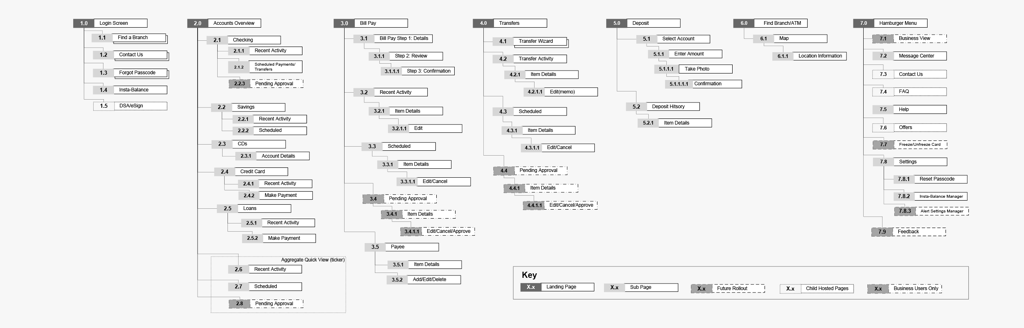
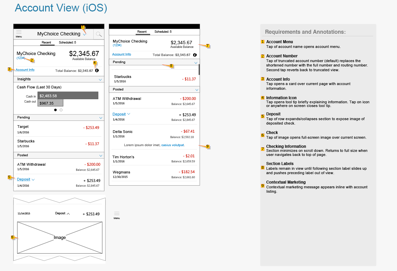
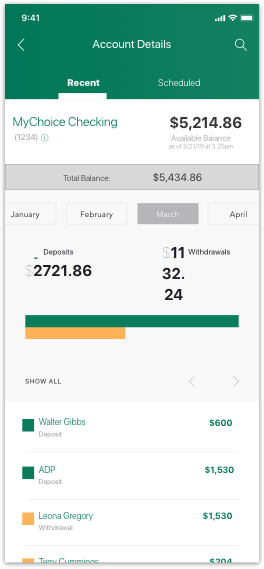
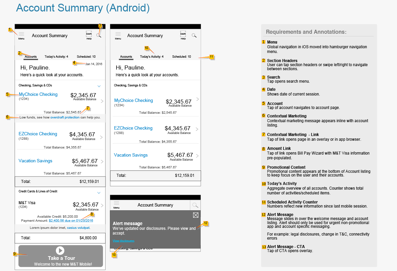
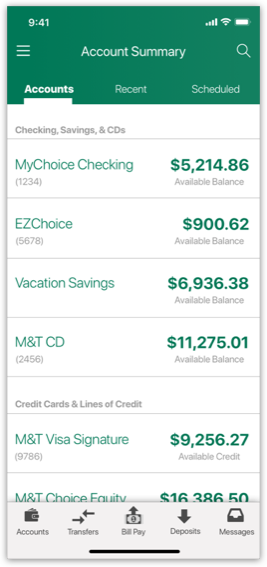
What shipped at the end of the engagement. The artifact lived inside the leadership that made it possible.The result was a clean, unified mobile banking app serving both personal and small-business customers across iOS and Android. The app focused on the highest-frequency mobile tasks (balance, check deposit, alert management, transaction search, payments) and shipped with an extensible UX framework that could grow with the bank's product roadmap and line-of-business expansion.
What this engagement demonstrates
Three credentials inside one engagement. The product shipped. The leadership held.- Leadership scope. A multi-disciplinary internal team (PM, designers, copywriter, programmer) and a multi-stakeholder client team (10–15 across the bank's lines of business), in a regulated industry, coordinated through engagement-level UX leadership rather than IA strand expertise alone.
- Stakeholder facilitation. A 2-day on-site workshop with 10–15 client stakeholders flown in from Buffalo; sustained client cadence across video-conference and in-person sessions through the full engagement lifecycle.
- Trust earned across hierarchy. Foundry 9 placed the engagement-lead role with a Senior IA because the project required it. The work shipped. The client engagement continued. The agency's unusual structural call was justified by the outcome.
This engagement predates the present documentation. Where post-launch performance metrics, call-deflection data, or the original workshop artifacts exist, they live in the original program's records at Foundry 9 rather than in my retained materials. The case here describes the leadership scope, the workshop structure, the team I led, and the artifact that shipped, drawn from working memory and the artifacts above. If a hiring conversation needs more detail, it's available on a call.
Additional work
Two further engagements from the agency years. The leadership discipline travels.The page is the procedure. Not the product.
An 18-month responsive-web evolution for Ethicon. UX strategy, IA, content strategy, and a custom information-retrieval framework grounded in cognitive science and library science.
A nonprofit, a workplace, and a game that lets you feel what neurodivergent employees feel
UX leadership across brand strategy, brand identity, microsite UX and content, and a Progressive Web App empathy game built around behavioral design and gamification principles.
Talk to Ben about your work
Engagement leadership is where regulated-industry product work tends to live or die.
The coordination layer (across teams, across stakeholders, across compliance gates and dependencies) is what determines whether the design actually ships. If that's where you are, the conversation starts here.